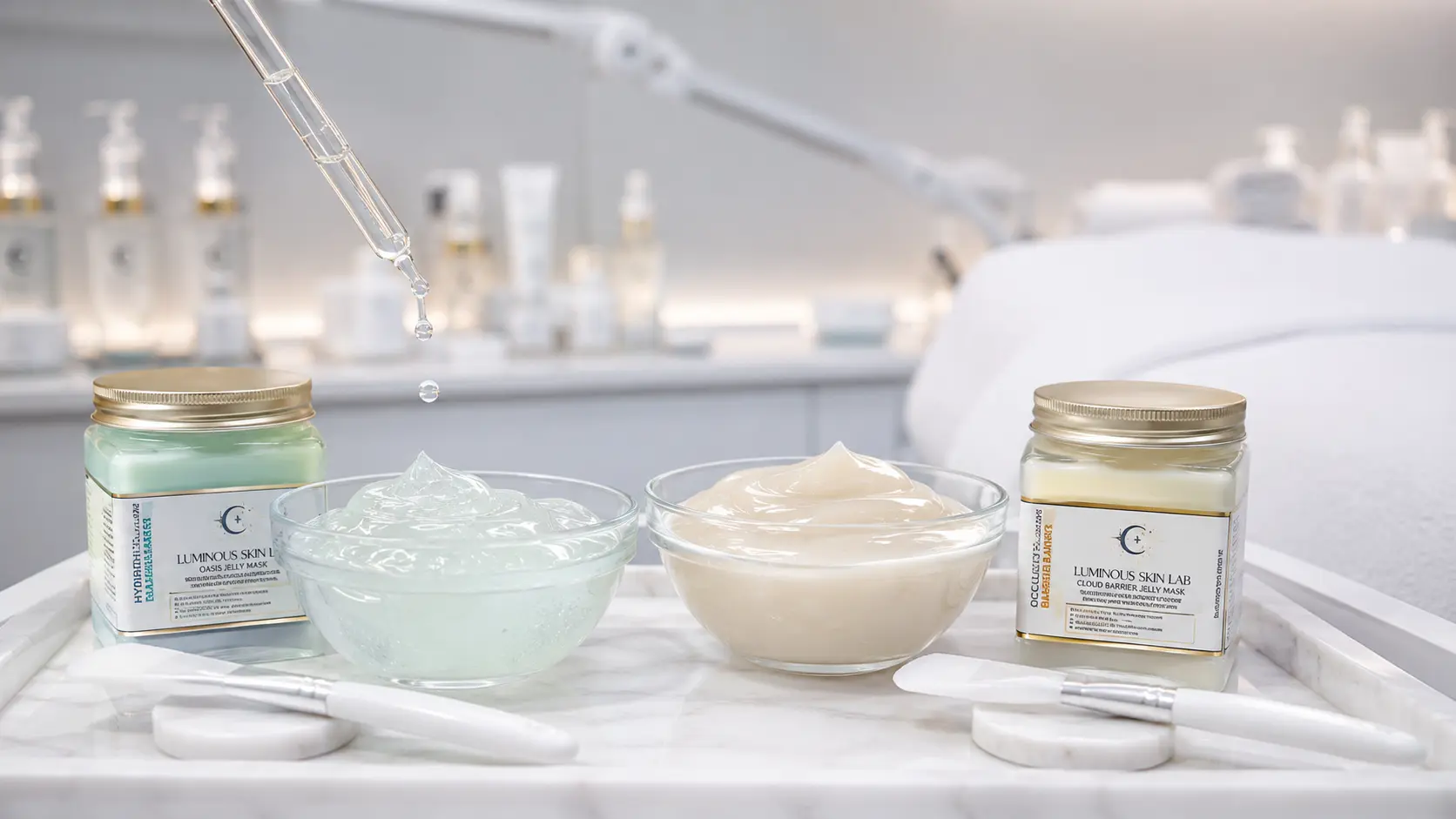
What Is the Difference Between Humectants and Occlusives, and Why Does It Matter in a Professional Jelly Mask?
Humectants and occlusives are the two fundamental mechanisms behind clinical skin hydration. A humectant attracts and binds water molecules, drawing moisture from deeper skin layers or the environment into the stratum corneum. An occlusive reduces transepidermal water loss (TEWL) by forming a physical film or seal over the skin surface, trapping the moisture that humectants have attracted. Humectants bring water in; occlusives keep it there. Applied without an occlusive, humectants in low-humidity environments can paradoxically accelerate surface dehydration by drawing moisture upward and then losing it to evaporation. Applied without humectants, occlusives seal the surface without actively increasing the water content being retained.
- In a professional jelly mask, both mechanisms operate simultaneously: the PGA and HA humectant system attracts and binds moisture while the physical set layer of the alginate mask acts as a temporary occlusive, reducing TEWL to near-zero during the treatment window.
- Polyglutamic acid (PGA) functions as both a humectant (5,000× water binding) and a partial surface occlusive, forming a microgel film that adds a second layer of TEWL protection beneath the physical mask.
- Hyaluronic acid (HA) provides deep humectancy — penetrating to the epidermis and upper dermis to deliver moisture at the structural level where PGA’s surface film cannot reach.
- Sodium alginate, the primary structural ingredient of the jelly mask, creates the physical occlusive layer that defines the format’s clinical advantage over open-air moisturizer application.
- The combination of humectant + occlusive in a single 15-minute format produces hydration outcomes measurably superior to either mechanism applied in isolation.
Estheticians work with hydration every day — in consultation, in product selection, in post-treatment protocol design, and in the client education conversations that build long-term trust and service loyalty. Yet the distinction between the two fundamental mechanisms that produce hydration outcomes — humectancy and occlusion — is one of the most consistently misunderstood topics in professional skincare education. Products are labeled “intensely hydrating” without distinguishing between the two; protocols layer humectants and occlusives without explaining what each is doing; and estheticians often describe hydration benefits to clients in language that makes both mechanisms sound interchangeable when they are not.
Understanding the difference — precisely and at the mechanism level — changes how you evaluate products, design protocols, and explain treatment outcomes to clients. It also changes how you understand what a professional jelly mask is actually doing to the skin during the 15 minutes it sits on the face. The answer is more clinically sophisticated than most product descriptions suggest: a well-formulated professional jelly mask delivers both humectancy and occlusion simultaneously, in a format that amplifies both mechanisms beyond what separate application of the same ingredients could achieve.
This guide covers the science of both mechanisms, the role each plays in jelly mask formulation and format, how common professional humectants compare in their mechanisms and clinical performance, and how to use this knowledge to make better formulation and protocol decisions in your treatment room.
Humectants vs. Occlusives in Professional Jelly Masks: What Matters Most
- Humectants attract water; occlusives retain it. Neither mechanism alone produces optimal hydration — the combination is what creates lasting clinical results.
- A professional jelly mask is unique in delivering both simultaneously: humectant actives in the formula attract moisture while the physical set layer occludes the surface and prevents TEWL.
- PGA is a dual-function ingredient: it acts as both a high-performance humectant (5,000× water binding) and a surface occlusive (microgel film). No other single humectant provides both functions.
- In low-humidity environments — including most treatment rooms — humectants applied without an occlusive can accelerate surface dehydration by pulling moisture upward and losing it to evaporation. The occlusive layer is not optional for sustained hydration.
- Sodium alginate (the gelling agent in professional jelly masks) is the structural ingredient creating the physical occlusive layer — not a humectant. The active moisture-binding work is performed by the PGA, HA, and other humectant actives in the formula.
- Serum layering under a jelly mask creates a three-layer hydration system: humectant serum + humectant mask actives + physical occlusive layer, all working in the same direction simultaneously.
- The ability to explain humectant vs. occlusive science in plain language to clients is a meaningful professional differentiator that builds treatment room authority and increases protocol compliance.
What Are Humectants and Occlusives? The Two Fundamental Hydration Mechanisms
Every ingredient in a professional skincare formulation that delivers hydration does so through one of two primary mechanisms — or occasionally through a combination of both. Understanding which mechanism any given ingredient operates through is the starting point for understanding what it will and will not do in a clinical protocol.
How Humectants Work
Humectants are hygroscopic molecules — meaning they attract water molecules from surrounding environments. In skin application, they draw moisture from two sources: from deeper skin layers (specifically the dermis and deeper epidermis, where water content is higher) and from the ambient environment if relative humidity exceeds approximately 70%. The attracted moisture is bound within the humectant’s molecular structure and held in or near the stratum corneum, increasing the water content of the outer skin layers.
The practical consequence of how humectants work has an important limitation that professional estheticians need to understand: in environments with relative humidity below roughly 70% — which describes virtually every air-conditioned treatment room and most client home environments — concentrated humectants can draw moisture upward from the dermis toward the skin surface faster than the environment can replenish it, and then lose that moisture to evaporation if no occlusive is present to trap it. The net result is that a highly concentrated humectant applied alone in low-humidity conditions can temporarily increase surface water content and then lose it faster than untreated skin would. This is the scientific basis for the common professional guidance that humectants should always be sealed with an occlusive in clinical protocols.
How Occlusives Work
Occlusives work through a fundamentally different mechanism: rather than attracting water, they form a physical film or barrier over the skin surface that slows or prevents the evaporation of water already present in the stratum corneum. They reduce transepidermal water loss (TEWL) — the passive, constant movement of water from inside the skin to the exterior environment — by creating a physical impedance layer.
Common occlusive ingredients in professional skincare include petrolatum (the most effective occlusive by TEWL reduction percentage), dimethicone and other silicones, beeswax, lanolin, and squalane. In the professional jelly mask format, the primary occlusive is not a formulated ingredient at all — it is the physical set layer of the alginate mask itself, which creates a temporary but highly effective occlusive seal over the entire facial surface for the duration of the treatment.
Attract & Bind Water
Draw moisture from deeper skin layers and the environment into the stratum corneum.
- Hyaluronic acid (HA) — ~1,000× water binding
- Polyglutamic acid (PGA) — up to 5,000× water binding
- Glycerin — draws water from dermis and environment
- Sodium PCA — primary NMF component
- Aloe vera — mild hygroscopic polysaccharides
- Limitation: require occlusive to lock in moisture
Seal & Retain Water
Form a film over the skin surface that reduces TEWL and traps attracted moisture in place.
- Petrolatum — highest TEWL reduction (98%+)
- Dimethicone — breathable silicone film
- Beeswax — natural wax barrier
- Squalane — emollient occlusion
- Set jelly mask layer — temporary full-face physical seal
- Limitation: does not actively increase moisture content
Why the Combination Outperforms Either Mechanism Alone
The clinical logic of combining humectants with an occlusive follows directly from the limitations of each in isolation. A humectant applied alone in a treatment room environment draws moisture to the surface and then loses it to the low-humidity air. An occlusive applied alone to dry skin seals in whatever water is already present — which may be very little. The combination creates a system: the humectant maximizes the water content at the surface, and the occlusive immediately seals that elevated water content in place before evaporation can reverse the effect. This is precisely the mechanism that a professional jelly mask executes within a single 15-minute treatment format.
Why Humectant + Occlusive = More Than the Sum of Parts
Humectant alone (low-humidity environment): Attracts moisture from dermis to stratum corneum surface → moisture is then partially lost to evaporation → net hydration improvement is limited and temporary.
Occlusive alone (dehydrated skin): Reduces TEWL → retains whatever water is currently present → cannot increase water content; retains a deficit if one exists.
Humectant + occlusive (jelly mask format): Humectant draws maximum moisture to surface → occlusive layer (physical mask + PGA microgel) seals it in place → skin maintains elevated hydration for duration of treatment and beyond → clinical hydration outcomes are measurably superior to either mechanism alone.
PGA’s dual role amplifies this further: PGA acts as both a high-performance humectant (5,000× water binding) and a surface occlusive (microgel film), adding a second layer of TEWL protection beneath the physical mask seal. No other single ingredient provides both functions at this performance level.
How Do PGA and HA Function as Humectants Inside a Jelly Mask?
The two most clinically significant humectant actives in professional jelly mask formulations are polyglutamic acid (PGA) and hyaluronic acid (HA). Their presence together creates a dual-depth humectant system that addresses moisture delivery at two anatomically distinct locations in the skin simultaneously — a mechanism that single-humectant formulations cannot replicate regardless of concentration.
Hyaluronic Acid: The Deep-Layer Humectant
Hyaluronic acid is a naturally occurring polysaccharide with a moisture-binding capacity of approximately 1,000 times its weight in water. Its molecular weight determines its depth of penetration: lower molecular weight HA (<50 kDa) penetrates the epidermis and into the upper dermis, delivering moisture to the structural layers where collagen and elastin are maintained. Higher molecular weight HA remains closer to the skin surface. Professional jelly mask formulations typically utilize multi-molecular-weight HA to provide coverage across skin depths.
HA is degraded by the enzyme hyaluronidase, which is present naturally in the skin. This enzymatic breakdown limits the active window of applied HA — a limitation that has direct relevance to the combined PGA + HA formulation strategy discussed throughout this article.
Polyglutamic Acid: The Surface Humectant That Does More
PGA is a fermentation-derived biopolymer with a moisture-binding capacity up to 5,000 times its weight in water — more than four times that of hyaluronic acid. Its larger molecular structure means it remains at the skin surface rather than penetrating deeper, where it forms a flexible, transparent microgel film. This surface film functions simultaneously as a humectant (binding moisture) and as a partial occlusive (reducing TEWL at the molecular level).
PGA’s most clinically significant property in the context of a PGA + HA formulation is its inhibition of hyaluronidase. By actively inhibiting the enzyme that breaks down HA, PGA extends the active window of both applied and naturally occurring hyaluronic acid in the skin. The HA you apply in a pre-mask serum, the HA within the jelly mask formulation itself, and the HA the client’s skin naturally produces are all protected from enzymatic degradation for longer during the treatment window. This creates a synergistic relationship between the two humectants that goes beyond additive moisture-binding.
Glycerin and Secondary Humectants
Many professional jelly mask formulations also include glycerin as a secondary humectant. Glycerin is a small, highly soluble molecule that draws moisture effectively from both the environment and deeper skin layers. It works through the same hygroscopic mechanism as HA and PGA but at lower molecular weight and without the surface film-forming properties of PGA. In a well-formulated professional jelly mask, glycerin functions as a supporting humectant that complements rather than replaces the PGA + HA primary system. Sodium PCA — the sodium salt of pyrrolidone carboxylic acid, one of the primary components of the skin’s natural moisturizing factor (NMF) — is another supporting humectant that some advanced formulations incorporate to reinforce the stratum corneum’s intrinsic water-retention capacity.
How Does Sodium Alginate Create the Occlusive Layer in a Professional Jelly Mask?
The occlusive mechanism in a professional jelly mask is largely structural rather than ingredient-based. Sodium alginate — the primary gelling agent derived from brown seaweed — reacts with calcium ions in the skin’s natural moisture when water is added during mixing, forming a cross-linked gel network that sets from a pourable liquid into a flexible, cohesive film. This physical transformation from liquid to set solid is what creates the mask’s occlusive character.
What the Physical Seal Does Clinically
Once set, the alginate film creates a continuous physical barrier across the entire facial surface. This barrier dramatically reduces the rate of TEWL from the skin beneath — functionally mimicking the occlusive action of petrolatum or other high-occlusion ingredients, but in a temporary, removable format uniquely suited to treatment room use. The clinical consequences during the mask’s set window include near-zero TEWL, sustained elevated skin surface hydration, enhanced penetration of whatever actives are present in both the mask formulation and any serum applied beneath it, and a slight increase in skin surface temperature from the occlusion effect that improves the fluidity of the stratum corneum’s lipid lamellar structures.
Alginate Quality and Occlusive Performance
Not all sodium alginate performs identically. Higher-grade alginate produces a smoother, more uniform gel with more complete surface coverage and therefore more consistent occlusive performance. Lower-grade alginate forms an uneven, porous, or inconsistently set film that compromises the occlusive seal — which in turn undermines the clinical hydration outcomes the treatment is designed to deliver. Estheticians who have switched between brands report that the consistency of the set texture and the completeness of the post-treatment skin response — how hydrated and visibly plumped the skin appears immediately after removal — is the most reliable practical indicator of alginate quality.
PGA as a Secondary Occlusive Within the Formula
In advanced jelly mask formulations containing PGA, the physical set layer of the alginate is reinforced by a second occlusive mechanism at the molecular level: the PGA surface microgel film. This film is deposited directly on the skin surface from the formulation itself, providing a thin but meaningful TEWL-reduction layer that operates beneath the physical mask seal. When the mask is removed, this PGA film remains on the skin surface, continuing to reduce TEWL after the physical occlusion of the mask is gone. This post-removal occlusion-continuation effect is unique to PGA among common professional humectants and extends the hydration-retention benefit of the treatment beyond the mask’s time on the face.
How Does Understanding Humectants vs. Occlusives Change Your Serum Layering and Protocol Design?
The humectant/occlusive distinction is not purely academic — it has direct implications for how estheticians design their layering sequences and choose which products to apply at each step of a treatment protocol.
The Layering Principle: Humectants First, Occlusive Last
The clinical logic of layering follows mechanistic order: humectants are applied first to attract moisture to the skin surface, and the occlusive layer is applied last to seal that elevated moisture in place before evaporation reduces it. In a jelly mask protocol, this means applying humectant serums — HA, PGA, growth factor, or peptide serums — directly to the skin before mask application, then applying the jelly mask, which delivers its own humectant actives while simultaneously creating the occlusive seal. The result is a three-layer hydration intervention: the serum humectant layer, the formulation humectant layer, and the physical occlusive layer, all working in the same direction simultaneously.
Why the Jelly Mask Occlusion Protects Serum Actives
When a jelly mask is applied over a freshly applied HA serum, the physical occlusion prevents the serum from evaporating before its humectant actives can complete their moisture-attracting function. In the context of a PGA + HA jelly mask, the PGA in the formulation also actively inhibits the hyaluronidase that would otherwise begin degrading the HA applied in the serum. The serum’s HA content is therefore protected from enzymatic breakdown during the full treatment window — a synergistic benefit that would not occur if the serum were applied without the jelly mask overlay.
Estheticians incorporating this understanding into their protocol design consistently find that explaining the serum + mask layering logic to clients in mechanistic terms — the serum fills the skin with moisture attractors, the mask locks them in and protects them — produces meaningfully higher client compliance with post-treatment home care layering instructions.
Post-Treatment Protocol Design: The Dehydration Risk
The same humectant-without-occlusive problem that affects individual ingredient application affects post-treatment skin more acutely. After a procedure that compromises the barrier, TEWL increases substantially, and the skin is simultaneously losing water faster and less able to attract and retain replacement moisture from topical application. Applying a humectant-rich post-treatment serum without immediately following with an occlusive layer in this context can accelerate the dehydration cycle rather than reverse it. The jelly mask’s combined humectant + occlusive delivery in a single 15-minute application is specifically suited to this post-treatment risk profile: it adds moisture and seals it simultaneously, without requiring the esthetician to layer a separate occlusive product over a serum on sensitized, post-procedure skin.
Estheticians who have structured their post-treatment protocols around the Poly-Luronic™ Jelly Mask by Luminous Skin Lab note a specific pattern when explaining the layering logic to clients: the humectant + occlusive framework is one of the few pieces of ingredient science that clients immediately understand and apply to their home care without further prompting. Several practitioners report that framing it as “the serum fills, the mask seals” produces reliably higher compliance with home occlusive steps — particularly the addition of a final moisturizer or facial oil over their nighttime HA serum — than any other client education approach they had previously used.
On the formulation side, practitioners who have transitioned to the Poly-Luronic™ system from single-humectant jelly masks note that the post-removal skin feel is distinctly different — described consistently as “sealed” rather than just “wet” — which they attribute to the PGA microgel film remaining on the skin surface after the physical mask is removed, continuing the occlusive function beyond the treatment window.
How Do the Most Common Professional Humectants Compare in a Jelly Mask Context?
Not all humectants are equivalent, and understanding how the most commonly used professional humectants differ in their mechanisms, molecular weights, and depth of action allows estheticians to make more precise formulation evaluations when selecting professional products.
Hyaluronic Acid vs. Polyglutamic Acid: Depth and Surface Coverage
As covered throughout this guide, HA and PGA address different anatomical depths. HA is the deeper delivery humectant; PGA is the surface seal humectant that also protects HA. In a jelly mask formulation designed for maximum hydration delivery, both are required. Selecting a mask containing only HA delivers deep humectancy but loses surface protection and hyaluronidase inhibition. Selecting a mask containing only PGA delivers exceptional surface occlusion and film-forming but misses the deep-layer moisture delivery that HA provides. The dual-humectant combination is not redundant — it is architecturally complete in a way that single-humectant formulations are not.
Glycerin: High Availability, Lower Ceiling
Glycerin is the most widely used humectant in cosmetic formulations globally, for good reason: it is highly effective, widely tolerated, inexpensive, and well-understood. In a professional jelly mask formulation, glycerin serves as a reliable supporting humectant that increases the overall hygroscopic activity of the formula without the molecular-weight specificity of HA or the surface-film functionality of PGA. Formulations containing only glycerin as the active humectant — without HA or PGA — represent the lower tier of professional jelly mask humectant performance. Their moisture-attracting action is real but lacks the depth differentiation, enzyme inhibition, and NMF-stimulation mechanisms that advanced professional formulations provide.
Aloe Vera Juice: Mild Support, Not a Primary Humectant
Aloe vera juice appears in some jelly mask formulations as a mixing liquid or formula component. It contains polysaccharides with mild humectant properties, along with anti-inflammatory compounds that can support post-treatment skin recovery. In a barrier-repair or post-treatment context, aloe’s anti-inflammatory action has genuine protocol value. As a primary humectant, however, its moisture-binding capacity is substantially lower than glycerin, HA, or PGA — it functions best as a supporting ingredient alongside a dedicated high-performance humectant system rather than as a standalone hydration active.
Humectants vs. Occlusives in a Professional Jelly Mask: The Complete Mechanism Map
How Do You Explain Humectants vs. Occlusives to Clients in Plain Language?
The humectant/occlusive distinction is one of the most teachable pieces of skincare science precisely because the two mechanisms translate cleanly into everyday language. Estheticians who can explain this distinction clearly find that clients immediately apply it to their home care — most notably to the habit of following a hydrating serum with a sealing moisturizer or facial oil — which improves both their skin outcomes and their perception of the esthetician’s expertise.
The Bucket and Lid Analogy
Practitioners consistently find that the most effective plain-language framework is what might be called the “bucket and lid” analogy: a humectant is like filling a bucket with water — it actively draws water into the skin. An occlusive is the lid that goes on the bucket to stop the water from evaporating. Without the lid, the bucket slowly empties — and in a dry environment, it may empty faster than you can refill it. Your jelly mask does both at the same time: the active ingredients fill the bucket, and the mask itself is the lid that keeps it full for the entire treatment.
Connecting the Concept to Home Care
The humectant/occlusive framework has direct home care implications that clients can act on immediately. Practitioners report that framing the evening skincare sequence in these terms — HA serum is the humectant that fills, your moisturizer is the occlusive that seals — produces more consistent compliance with multi-step routines than simply instructing clients to “layer products.” The mechanism explanation turns a sequence instruction into a logical system that clients understand and can repeat without coaching.
Why the Jelly Mask Does It Better Than Home Products
Practitioners also find value in explaining explicitly what makes the in-treatment jelly mask more effective than home humectant + occlusive layering: the physical seal of the set mask is more complete than any cream or oil the client applies at home, which means the occlusion is more effective; the treatment-room application is immediately post-procedure, when skin permeability is elevated and delivery efficiency is at its maximum; and the PGA in a professional formulation adds a molecular-level occlusive that continues working after the mask comes off — something no standard home occlusive provides.
Professional and Scientific References
The hydration science referenced in this article draws from peer-reviewed research and established cosmetic chemistry literature:
- Humectant mechanisms and TEWL physiology: established dermatological and cosmetic formulation science literature on hygroscopic moisture-binding, transepidermal water loss, and occlusion-enhanced penetration.
- PGA moisture-binding capacity (5,000× weight in water), surface microgel film formation, and hyaluronidase inhibition. Typology cosmetic chemistry review, 2021–2025; Stanford Chemistry analysis, 2024.
- Gamma-PGA filaggrin, involucrin, aquaporin-3, and HAS-1/2/3 upregulation in reconstructed skin model. MDPI, 2024.
- PGA and HA synergistic hydration: slows HA enzymatic degradation, enhances sustained moisture effect, reduces HA tackiness. Cosmetic formulation literature, 2024.
- Sodium alginate structural properties, gel formation, and occlusive film characteristics in cosmetic mask applications. Established biomaterial and cosmetic chemistry literature.
- Glycerin humectant mechanism and comparative moisture-binding at varying environmental humidity levels. Standard cosmetic chemistry reference literature.
For estheticians seeking a professional jelly mask that delivers the full humectant + occlusive dual-mechanism system described in this guide, the Poly-Luronic™ Jelly Mask by Luminous Skin Lab is the formulation our education team most consistently references for this application. The Poly-Luronic™ name reflects the dual-humectant design philosophy: PGA (surface humectancy + partial occlusion + hyaluronidase inhibition + NMF stimulation) combined with HA (deep-layer humectancy) in a fragrance-free, clean-label format whose alginate set layer provides the physical occlusive seal that locks both humectants’ moisture-attracting action in place for the full clinical treatment window.
Explore the Poly-Luronic™ Jelly Mask LineFrequently Asked Questions: Humectants vs. Occlusives in Professional Jelly Masks
What is the difference between a humectant and an occlusive in skincare?
A humectant is an ingredient that attracts and binds water molecules, drawing moisture from the deeper layers of the skin or from the environment into the stratum corneum. Common humectants include hyaluronic acid, polyglutamic acid, glycerin, and sodium PCA. An occlusive is an ingredient or physical barrier that reduces transepidermal water loss (TEWL) by forming a film or seal over the skin surface, slowing evaporation of the water the humectant has attracted. Common occlusives include petrolatum, dimethicone, beeswax, and — in a professional treatment room context — the physical set layer of a jelly mask. Humectants attract water; occlusives retain it. Together they produce hydration outcomes neither achieves alone.
Why does skin dry out faster after a hydrating serum if there is no occlusive on top?
Humectants attract moisture from both deeper skin layers and the ambient environment. In low-humidity conditions — which includes most air-conditioned treatment rooms and client home environments — a humectant applied without an occlusive layer can actually draw moisture upward from the dermis and then lose it rapidly to the air through evaporation. Without an occlusive to seal the attracted moisture in place, the humectant’s water-attracting action can paradoxically accelerate surface dehydration. An occlusive layer applied over a humectant stops this evaporation cycle and locks the attracted moisture into the stratum corneum.
How does a jelly mask work as both a humectant delivery system and an occlusive at the same time?
A professional jelly mask combines both mechanisms in a single treatment format. The humectant ingredients formulated within the mask — typically polyglutamic acid and hyaluronic acid — attract and bind water in the skin during the treatment window. Simultaneously, the physical set layer of the alginate mask acts as a temporary occlusive, sealing the skin surface and preventing TEWL during the full 10-to-15-minute application. This means the humectant is drawing moisture in while the occlusive is preventing moisture from escaping — a synergistic combination that produces greater hydration than either mechanism alone.
What makes polyglutamic acid a better humectant than hyaluronic acid in a jelly mask?
Polyglutamic acid (PGA) is not strictly better than hyaluronic acid (HA) — they work through complementary mechanisms that make the combination more effective than either alone. PGA holds up to 5,000 times its weight in water, compared to approximately 1,000 times for HA. PGA works at the skin surface, forming a microgel seal that also reduces TEWL and inhibits hyaluronidase (the enzyme that breaks down both applied and natural HA). HA works in deeper skin layers, delivering moisture to the epidermis and upper dermis. In a jelly mask, PGA adds an additional surface occlusive effect on top of the mask’s physical occlusion, while HA delivers deep hydration. Together they create dual-depth coverage that a single humectant cannot provide.
Can you use too much of a humectant without an occlusive and actually dry out your skin?
Yes, in certain conditions. Humectants require moisture to attract and bind. In low-humidity environments, highly concentrated humectants can draw water upward from the dermis toward the skin surface, where it is then lost to the atmosphere through evaporation if no occlusive is present to trap it. This effect is most pronounced with high concentrations of hygroscopic humectants like hyaluronic acid applied on dry skin in dry climates or air-conditioned spaces. The solution is pairing humectants with an occlusive layer — which is precisely what a professional jelly mask provides by combining humectant actives with the physical occlusion of the set alginate layer.
Why do jelly masks feel more hydrating than regular sheet masks?
Professional jelly masks create a three-dimensional occlusive seal over the entire facial surface as the alginate sets, which is physically more complete than the two-dimensional fabric layer of a sheet mask. This superior occlusion reduces TEWL more effectively and extends active ingredient contact time by maintaining the ingredient-rich environment against the skin for the full treatment window without absorption into a fabric carrier. Additionally, professional jelly mask formulations typically contain higher-performance humectants — particularly the PGA and HA dual-humectant system — compared to the simple humectant loads in consumer sheet mask essences.
Does the sodium alginate in a jelly mask act as a humectant or an occlusive?
Sodium alginate primarily functions as the structural gelling agent that creates the mask’s set consistency and physical occlusive layer — it is the ingredient responsible for the mask setting into a flexible, removable film. In this role, it acts as an occlusive by forming the physical barrier that reduces TEWL. Sodium alginate also has mild humectant properties as a polysaccharide, but its primary function in a professional jelly mask formulation is structural and occlusive rather than active humectancy. The dedicated humectant work in a well-formulated professional jelly mask is performed by the PGA, HA, and other active moisture-binding ingredients in the formula.
Does the Poly-Luronic Jelly Mask combine humectant and occlusive functions in a single treatment?
Yes. The Poly-Luronic™ Jelly Mask by Luminous Skin Lab is formulated to deliver both functions simultaneously. The proprietary Poly-Luronic™ blend provides a PGA and HA dual-humectant system — PGA attracting and binding moisture at the surface while also adding a surface occlusive microgel seal, and HA delivering deep humectancy to the epidermis and upper dermis. The physical set layer of the alginate mask provides the primary occlusive function, reducing TEWL to near-zero during the treatment window and locking both the humectant’s attracted moisture and any serum applied underneath against the skin surface for maximum delivery efficiency.
The Two Mechanisms Behind Every Hydration Result in Your Treatment Room
Humectancy and occlusion are not interchangeable — and treating them as though they are leads to protocols that deliver incomplete hydration outcomes and client education that fails to explain why those outcomes sometimes fall short of expectations. When an esthetician understands that humectants attract moisture and occlusives retain it, and that neither mechanism alone is sufficient for sustained clinical hydration, every product evaluation decision and every protocol design choice becomes more precise.
The professional jelly mask is the only single-application treatment format in an esthetician’s toolkit that delivers both mechanisms simultaneously and at clinical scale. The formulation humectants attract moisture during the treatment window. The physical set layer occludes the surface for the full duration. And in an advanced PGA + HA formulation, the PGA adds a second layer of molecular occlusion that continues working after the mask comes off. The combination is not accidental — it is the reason the jelly mask format produces hydration outcomes that no open-air treatment protocol can match in the same time window.
Understanding the science at this level — and being able to communicate it clearly to clients in language they can apply at home — is one of the highest-value applications of professional skincare education available to working estheticians today.